
As featured in ELEVATE MAGAZINE
How to Use Data Strategically in Your HR Role
By Lorna Moles · Originally published in ELEVATE MAGAZINE, June 2026
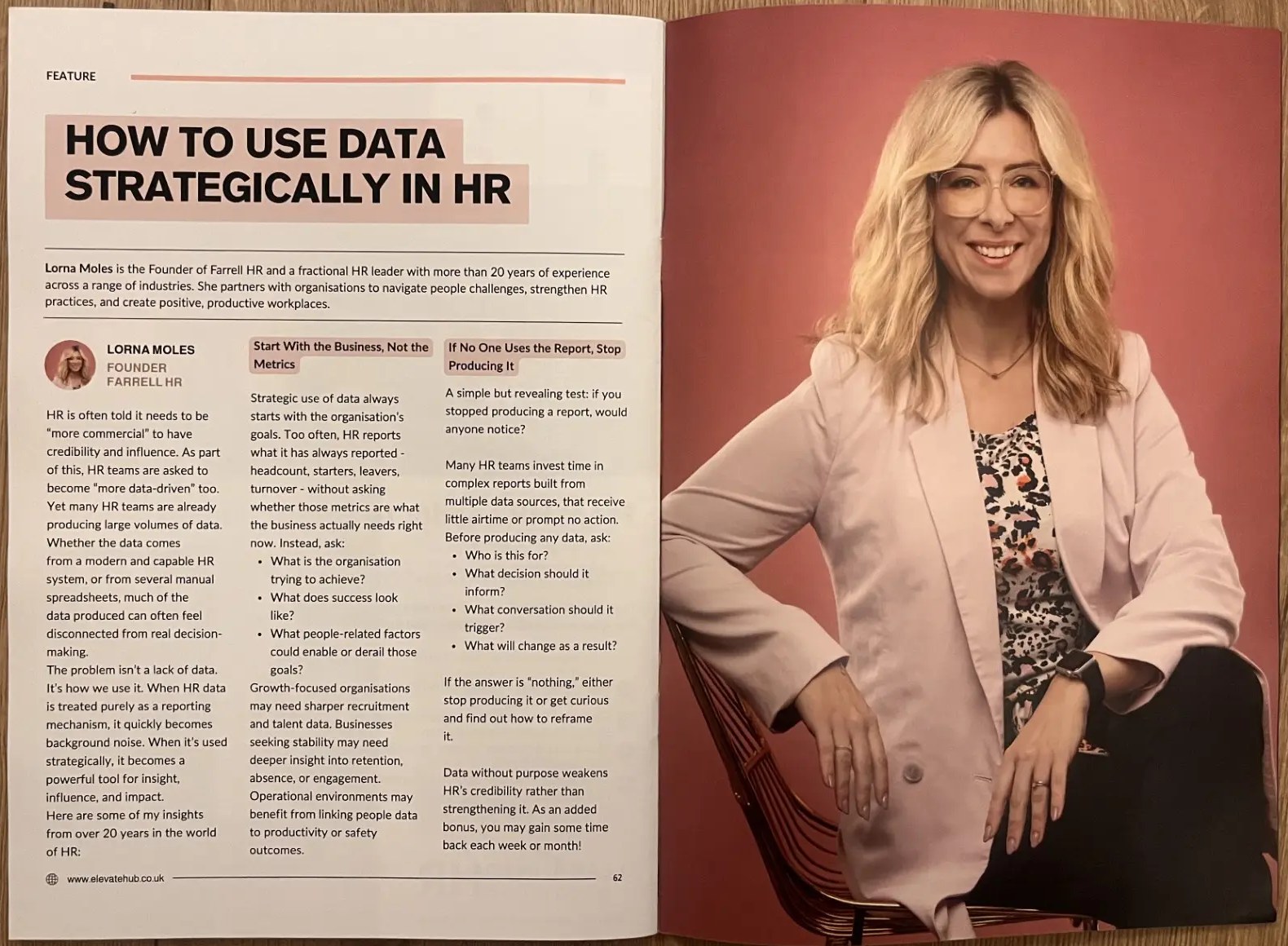
HR is often told it needs to be “more commercial” to have credibility and influence. As part of this, HR teams are asked to become “more data-driven” too.
Yet many HR teams are already producing large volumes of data. Whether the data comes from a modern and capable HR system, or from several manual spreadsheets, much of the data produced can often feel disconnected from real decision-making.
The problem isn’t a lack of data. It’s how we use it.
When HR data is treated purely as a reporting mechanism, it quickly becomes background noise. When it’s used strategically, it becomes a powerful tool for insight, influence, and impact.
Here are some of my insights from over 20 years in the world of HR:
Start with the business, not the metrics
Strategic use of data always starts with the organisation’s goals. Too often, HR reports what it has always reported (headcount, starters, leavers, turnover) without asking whether those metrics are what the business actually needs right now.
Instead, ask:
- What is the organisation trying to achieve?
- What does success look like?
- What people-related factors could enable or derail those goals?
Growth-focused organisations may need sharper recruitment and talent data. Businesses seeking stability may need deeper insight into retention, absence, or engagement. Operational environments may benefit from linking people data to productivity or safety outcomes.
If no one uses the report, stop producing it
A simple but revealing test: if you stopped producing a report, would anyone notice?
Many HR teams invest time in complex reports built from multiple data sources, that receive little airtime or prompt no action. Before producing any data, ask:
- Who is this for?
- What decision should it inform?
- What conversation should it trigger?
- What will change as a result?
If the answer is “nothing,” either stop producing it or get curious and find out how to reframe it. Data without purpose weakens HR’s credibility rather than strengthening it.
As an added bonus, you may gain some time back each week or month.
Data is more than numbers
People data isn’t just spreadsheets and dashboards. Qualitative insight (feedback from employees, themes from manager conversations, observations from workshops) is data too.
This type of information often provides the “why” behind the numbers and gives leaders something concrete to act on.
Tell stories, not just stats
Data alone rarely changes minds. Stories do.
Strategic HR storytelling links people data to business reality, connecting numbers to human experience and organisational outcomes. It adds context, emotion, and meaning, helping leaders understand not just what’s happening, but why it matters.
Position people data as business data
Perhaps the most important belief is this: people data IS business data.
It deserves the same attention as financial or sales metrics. When HR presents data confidently, links it to strategy, and communicates it clearly, it earns its place in decision-making, not as an “extra,” but as essential.
Three simple actions you can take today
1. Stop one report for a month
Pause a regular HR report and see if anyone asks for it. If no one does, that’s your signal to either stop producing it altogether or redesign it around real business questions.
2. Ask one “so what?” question in your next meeting
When presenting data, follow it with a clear “so what?”: What does this mean for the business, and what needs to change as a result? This simple shift moves data from information to insight.
3. Have one curiosity-led conversation
Pick one data point, positive or negative, and speak to the people behind it. Ask what’s driving it and what would make the biggest difference. That conversation alone can unlock more value than another bar chart ever will.
This article was originally published in ELEVATE MAGAZINE in June 2026.